Can ChatGPT Make OCD Worse? How AI Can Fuel OCD and Online Checking
February 17, 2026
If you’ve recently Googled “can ChatGPT make OCD worse,” I already know a few things about you.
You’ve probably asked it something about your intrusive thoughts. Maybe more than once. Maybe you rephrased the prompt to make sure it really understood you. Maybe you felt relief when it answered clearly. And then maybe… you opened it again an hour later just to double-check.
You are not the only one doing this.
The short answer to whether ChatGPT can make OCD worse is yes, it can. But the reason has less to do with technology and more to do with how OCD works.
OCD runs on doubt. It feeds on uncertainty. And when you hand it a tool that gives structured, confident answers on demand, your brain can start using that tool as a way to feel safe.
That is where things get sticky.
Why ChatGPT Feels So Helpful When You Have OCD
When you’re dealing with intrusive thoughts, your brain wants clarity. It wants a clean explanation. It wants someone to tell you what this means and whether you’re okay.
ChatGPT delivers information in a calm, organized way. It responds directly to you. It sounds measured. It doesn’t panic. Compared to scrolling Reddit threads at midnight or falling down Google rabbit holes, it feels stable.
So you type:
“Is this harm OCD or am I actually dangerous?”
“Why does my brain keep telling me I’m a bad person?”
“Can intrusive thoughts mean something about who I am?”
You get an answer that explains intrusive thoughts. You feel your body relax. Your shoulders drop. Your heart slows down.
That relief feels like progress.
And in that moment, it feels harmless. This is the OCD and anxiety cycle in real time. To see it in action, click here for my masterclass.
How ChatGPT Can Become a Compulsion
Here’s what I see happening in real life.
Someone asks once. It helps. A few days later, a new doubt pops up. They open the app again. This time, they add more detail. They want the answer to really apply to their situation.
Then something subtle shifts.
Instead of learning about OCD in general, they start using ChatGPT to calm specific spikes of anxiety.
It becomes part of the ritual.
You wake up uneasy. You ask.
You feel a wave of doubt after a conversation. You ask.
You get a random intrusive thought while driving. You ask.
You might not even realize it’s happening. It just becomes automatic. Anxiety rises. Open the app. Type the question. Wait for the reassurance.
OCD does not care whether reassurance comes from Google, your partner, a therapist, or a chatbot. What it cares about is that you are trying to eliminate uncertainty instead of tolerating it.
If you notice yourself refining prompts over and over because the first answer “didn’t fully settle it,” that is your clue.
Research Versus Reassurance
Learning about OCD is useful. I encourage psychoeducation. Understanding the OCD cycle changes lives. If you have never learned how the cycle works, go watch my OCD and Anxiety Cycle Masterclass. It explains the pattern clearly so you can see what your brain is doing instead of feeling trapped inside it.
But there’s a difference between learning once and using information as a soothing device.
Research has a stopping point. You read. You absorb. You move on.
Reassurance has urgency. It feels like you cannot rest until you get one more answer. It pulls you back in. It convinces you that this time, if you just ask it correctly, you will finally feel done.
Except you rarely feel done.
You feel better for a minute. Then your brain goes, “But what if…”
And the loop starts again.
The Midnight Spiral Scenario
I’ll paint you a real picture because this is what I see in my DMs.
It’s 11:47pm. You’re in bed. You suddenly remember something you said three years ago. Your brain decides this might mean you’re secretly a terrible person.
You open ChatGPT and type out a detailed explanation of the memory. You ask whether this sounds like OCD or evidence that you’re morally flawed.
You get a thoughtful response explaining intrusive thoughts and cognitive distortions.
You breathe out.
Ten minutes later, a new thought creeps in. What if you left out an important detail? What if the answer would change if it knew that one extra piece of context?
Back to the app.
That pattern is not about curiosity. It’s about safety and urgency and control and desperation.
So What Do You Do Instead?
I am not going to tell you to delete the app. That would be dramatic and unrealistic.
Instead, start noticing the moment your brain reaches for it.
Pause and ask yourself: am I trying to understand something new, or am I trying to make this anxiety go away right now?
Those are two very different motivations.
If your goal is immediate relief, that’s usually your cue that you are feeding the cycle.
This is where recovery starts to feel uncomfortable in a productive way. Instead of opening the app, you sit there with the unfinished feeling. You let the doubt hang in the air. You move your body. You go brush your teeth. You do literally anything else while your brain complains.
That builds strength.
It’s awkward. It’s buzzy. It’s not glamorous. I say that as someone who has had to practice this in my own life.
Grounding Without Turning It Into Another Ritual
When you’re working on breaking online checking habits, visual anchors can help. Something in your physical space that reminds you of your commitment to stay steady.
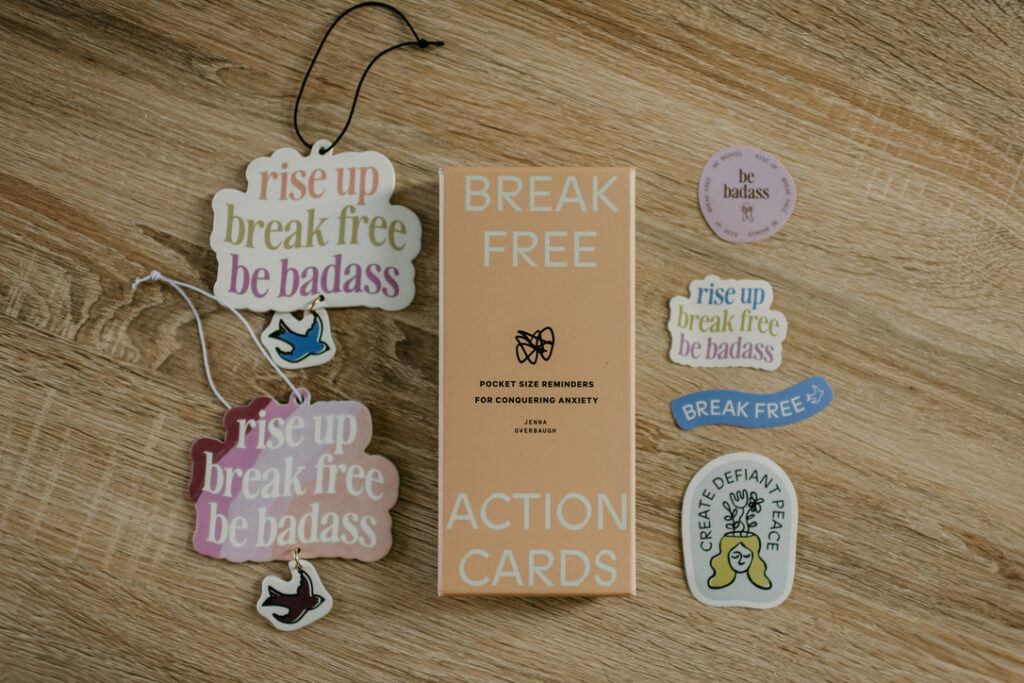
That’s actually why I created the Break Free merch collection. The affirmation cards, stickers, sweatshirts, even the air fresheners – they are not decorative fluff. They are physical reminders in the exact moments when your brain wants to spiral.
For example, one of my favorite scripts is: “Maybe, maybe not. Moving forward anyway.”
Imagine seeing that on your mirror instead of opening another browser tab.
You can check out the full collection here.
These tools are not about eliminating anxiety. They help you remember who is in charge when anxiety starts doing the most.
If You’re Wondering Whether This Is You
If any part of this blog felt uncomfortably accurate, I want you to take my free quiz:
Which Type of Anxious, Online Checker Are You?
It walks you through how your brain uses Google, Reddit, or ChatGPT and shows you the specific pattern you tend to fall into.
Because not everyone checks the same way.
Some people compare subtypes for hours.
Some reread the same AI answer five times.
Some bounce between three platforms trying to get the “final” confirmation.
The quiz will give you language for your pattern and help you see what’s really driving it.
You can take it by clicking here.
Final Thought
Technology keeps evolving. OCD’s mechanism does not.
Your brain will always look for ways to feel certain. It will use whatever tools are available. AI just happens to be the newest one.
The real work happens when you decide you are willing to feel unfinished for a minute. When you resist the urge to answer the question one more time. When you stay in the room with the doubt instead of chasing relief.
That part is not flashy. It is also where your freedom lives.
Anyway. I’m still practicing this too. We’re in this together.
xo Jenna



most popular episodes
Love my podcast?
Episode 112: Postpartum OCD and False Memory OCD
Imagine how in depth I can go in an online course. Instantly downloadable and game-changing. Take the next step towards an amazing life.