Is Googling Your Symptoms a Compulsion?
February 24, 2026
If you’ve found yourself asking, “is googling your symptoms a compulsion,” there’s a good chance you’re not just casually curious. That question usually shows up after you’ve already Googled the thing. Maybe more than once. Maybe you told yourself it was “just to check.” Maybe you got a little relief, and then your brain immediately moved the goalpost and wanted one more search to feel fully settled.
And if you’re reading this thinking, “Okay wow, rude,” I get it. This pattern is incredibly common for OCD and anxiety. It’s also one of the most misunderstood, because on the outside it looks like someone being responsible. On the inside, it often feels like someone trying to survive discomfort.
So let’s talk about it clearly: when does Googling cross the line from normal information-gathering into compulsive online checking, and what do you do if you recognize yourself in this?
Why Googling feels so logical when you’re anxious
When anxiety shows up, your brain immediately starts scanning for certainty. You want an answer that makes the uncomfortable feeling go away. You want closure. You want to know whether what you’re feeling is normal, dangerous, meaningful, “a sign,” or proof that you need to panic.
Googling feels like a reasonable solution because it offers a quick hit of information. It also gives you something else, and this part matters more: it gives you the illusion of control. When you’re anxious, you don’t just feel scared, you feel unsteady. Searching gives you something to do. It makes you feel proactive. It makes you feel like you’re handling it.
That’s why this habit is so sticky. It often starts from a place that looks responsible. You’re not trying to “feed OCD.” You’re trying to feel okay.
When Googling becomes a compulsion
So how do you know if Googling your symptoms is a compulsion?
The biggest clue is not the content of what you’re searching. The biggest clue is the function. What is the search doing for you?
When it’s a compulsion, Googling becomes a way to reduce anxiety in the moment. It’s reassurance-seeking in a modern format. You search, your anxiety drops, and your brain files that away as proof that searching works. Then, the next time anxiety hits, your brain urges you to search again.
Another clue is repetition. You don’t search once and move on. You search, feel temporary relief, then search again because something didn’t “land” right. You reword the question. You read five sources to make sure they all agree. You find one sentence that scares you and suddenly you’re not searching for information anymore, you’re searching for the magical answer that makes you feel safe again.
That’s why people get trapped. The goal becomes “I need to feel certain,” and the internet is endless.
The “good moment” that turns into a spiral
This part is what people don’t expect.
A lot of the time, the spiral doesn’t start because something terrible happened. It starts because you had a weird feeling or an intrusive thought and your brain decided it mattered.
Maybe you noticed a symptom and thought, “That’s odd.” Maybe you remembered something you said and felt a wave of guilt. Maybe your brain threw you a classic intrusive thought like, “What if you’re secretly a bad person?” and you felt that hot flush of fear.
Then the urge hits: “Just look it up.” And you do.
For a moment, it helps. You find an explanation that sounds reassuring. Your body settles. You think you’re done.
Then your brain goes, “Wait… but what about this detail?” Or, “What if that article is wrong?” Or, “What if my situation is different?”
That’s how online checking becomes a loop. The loop isn’t about the internet. The loop is about intolerance of uncertainty, and OCD is basically a professional at making uncertainty feel like an emergency.
Why information doesn’t solve an anxiety loop
Here’s the frustrating truth. You can understand OCD. You can be smart. You can read all the things. You can even know you’re reassurance-seeking while you’re doing it.
And still feel pulled to search.
Because this isn’t a knowledge problem. It’s a relief pattern.
Your brain learns through reinforcement. If searching reduces anxiety even temporarily, your brain will want to repeat it. That’s why this habit can feel almost automatic, like your fingers move before you’ve fully decided.
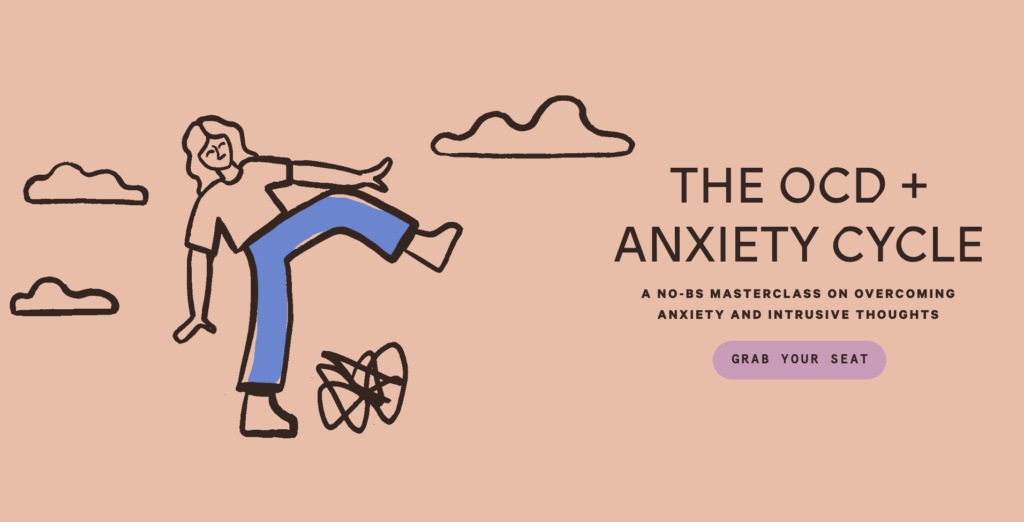
Once you can see the cycle, you can stop treating your behavior like a personal flaw and start treating it like a pattern you can change.
What to do instead of Googling (without white-knuckling it)
A lot of people hear “stop Googling” and immediately think, “Cool, so I’m just supposed to sit here and panic?”
No. You’re not trying to be a hero. You’re trying to retrain your brain.
So start smaller.
The moment you notice the urge to Google, pause long enough to identify what you’re really seeking. Usually it’s one of these things:
- reassurance that you’re safe
- reassurance that you’re not “bad”
- reassurance that this thought doesn’t mean anything
- reassurance that you’re not the exception
Then instead of searching, practice letting the question exist without finishing it. That feels uncomfortable, because your brain wants closure. Over time, that discomfort becomes tolerable. And when that happens, your brain stops treating uncertainty like a five-alarm fire.
That’s the skill online checking blocks. Online checking keeps the “uncertainty intolerance” muscle weak. Breaking the habit strengthens it.
Why this matters right now (and what I’m doing about it)
Online checking has become the modern OCD trap. People used to do it through WebMD and forums. Now it’s Google, Reddit, TikTok, and ChatGPT. The platforms change, but the cycle stays the same. It’s still doubt. It’s still urgency. It’s still reassurance. It’s still temporary relief followed by “but what if.”
We’re going to talk about how to spot online checking quickly, what to do instead in the moment, and how to break this pattern without feeling like you have to become a monk who never uses the internet again.
If this blog felt like it was describing your life a little too well, save your seat here.



most popular episodes
Love my podcast?
Episode 112: Postpartum OCD and False Memory OCD
Imagine how in depth I can go in an online course. Instantly downloadable and game-changing. Take the next step towards an amazing life.