When “Fun” Turns Into Spiraling: Why Good Times Don’t Always Feel Good With OCD & Anxiety
December 16, 2025
You know those moments when everything is supposed to be fun. The party, the dinner, the holiday magic.. and suddenly your brain crashes the scene like the MOST chaotic uninvited guest? Everyone else is laughing and bonding and sipping hot cocoa, and meanwhile you’re silently having an existential crisis near the charcuterie board (not that anyone would even know, because you play it off like everything’s fine). You look around at everyone else having a great time and wonder why your brain has to be so off. You just want to be normal like everyone else.
Why does OCD and anxiety always have to butt in during the good times?
If this rings painfully true, there is nothing wrong with you. “Good moments” can be just as triggering as stressful ones for people with OCD and anxiety, and you’re not failing because joy feels complicated.
A lot of people think anxiety shows up only when life is hard, but here’s the curveball: OCD often spikes when things are going well. The brain senses vulnerability in happiness, connection, excitement, or peace and decides to “protect” you with – you guessed it – intrusive thoughts, doubt, checking, rumination, self-monitoring, and panic. It’s not sabotage because you’re weak; it’s sabotage because your brain hasn’t learned yet that joy is safe.
Why Good Moments Feel Dangerous to an Anxious Brain
When life gets calm or enjoyable, your brain no longer feels “prepared.” Anxiety interprets that lack of vigilance as a threat, not relief. So it turns on the alarms: “Don’t get too comfortable.” “This won’t last.” “Something bad is going to happen.” “You’re not really happy.” “You don’t deserve this.”
Sound familiar?
Instead of letting you sink into warmth and presence, OCD tries to yank you out of the moment and into mental analysis. It says, “If I can get ahead of the discomfort, I can prevent it.” But the act of bracing for danger is what creates the danger. The moment your brain starts auditing whether you’re happy enough or connected enough or safe enough, joy gets replaced by pressure.
The Spirals That Ruin Good Times
The spirals don’t always look dramatic. Sometimes they’re subtle, and the outside world has no idea you’re drowning. You might catch yourself monitoring your emotions during the event, questioning whether you’re present enough, obsessing over how others are perceiving you, or suddenly trying to figure out whether you’re having “the correct amount of fun.” You might even mentally rehearse memories – “Was that moment good enough? Was I acting weird? Did I ruin it?” – long after everyone goes home.
None of this means you’re ungrateful. None of this means you don’t love your people. None of this means you’re not enjoying life. It just means joy has become tangled up with fear, and your brain is trying to control something that isn’t meant to be controlled.
The Real Problem: Trying to “Feel Right”
If there’s one thing that destroys joy faster than intrusive thoughts, it’s trying to “feel right” during a good moment. That pressure to prove you’re happy, prove you’re connected, prove you’re safe – it becomes its own spiral. And here’s the catch: the more you chase a feeling, the more impossible it becomes to feel.
Happiness isn’t a performance metric. It’s not supposed to be measured, monitored, checked, or confirmed. It’s something you experience on the way to something else, not something you master on command.
So How Do You Stay Present When Your Brain Won’t Let You Enjoy Good Things?
The key isn’t forcing yourself to feel differently. The key is letting the moment be messy if it needs to be. You don’t need to feel 100% happy to be having a good time. You don’t need to feel connected in order to be connecting. Presence isn’t about purity, it’s about participation.
A mindset that helps a lot of my students is:
“Joy doesn’t need to be perfect to count.”
If your brain throws doubts during a good moment, it doesn’t mean the moment is ruined. It just means your brain got freaked out by vulnerability. And that can happen even when nothing is going wrong.
Sometimes the most powerful act of recovery is allowing joy to feel clumsy and staying in the experience anyway.
Tools That Help During “Good Times That Turn Bad”
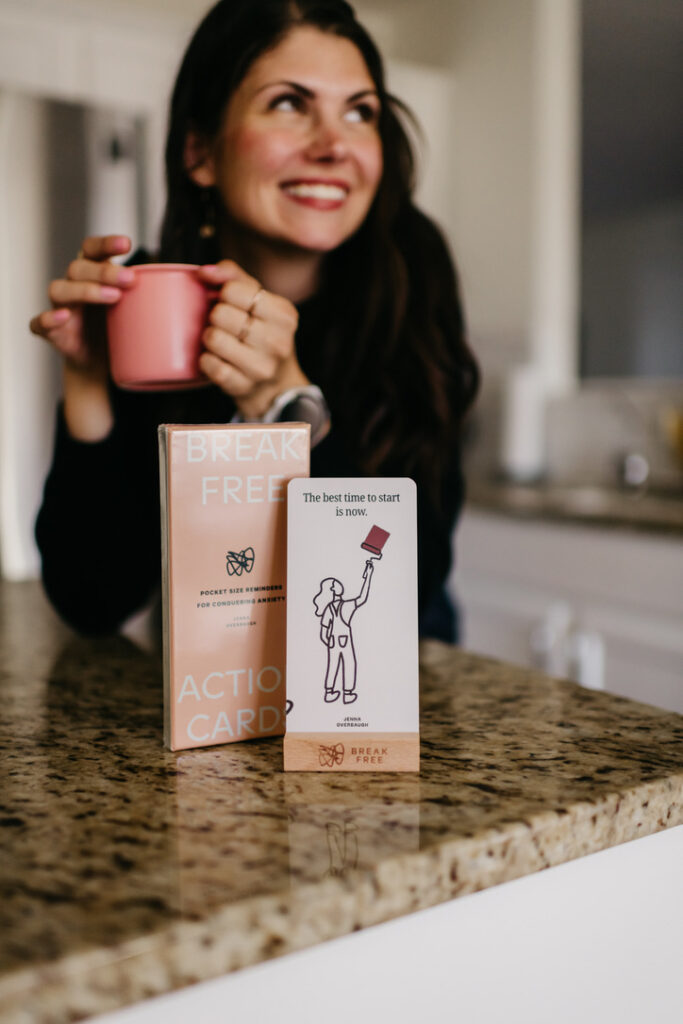
People often think grounding tools are just for hard moments, but they shine during good moments too, especially when your brain is trying to panic its way out of peace. Many of my students use visual grounding during events so they don’t slip into rumination unnoticed. A sticker on a phone case or bathroom mirror, an air freshener on the car visor, or a sweatshirt with a power statement can interrupt spirals without slipping into reassurance. These tools aren’t about comfort; they’re about identity reinforcement – reminders of who you’re becoming.
Even so, grounding tools alone can’t solve the deeper issue if joy itself feels unsafe. That pattern doesn’t shift through coping skills- it shifts through breaking the OCD cycle at the root.
If You Want Good Things to Feel Good Again…
You don’t need to pressure yourself to “enjoy the holidays,” “be positive,” or “feel grateful.” What you need is a system that actually teaches your brain:
- joy is safe
- presence is safe
- uncertainty is survivable
- happiness doesn’t mean danger is coming
The Blueprint gives you the full step-by-step process to break the OCD cycle long-term, not just survive it during the holidays. It includes community support, guidance from me every week, worksheets, and resources for every subtype and every stage of recovery.
If you’re someone who’s trying hard, doing the work, exhausted by spiraling, and truly wants to enjoy moments again, this is where everything changes.
You deserve to experience the good things in your life without fighting your brain the whole time.
And I would love to walk you there. Join the over 800+ students (and me!) inside today.
xo, Jenna



most popular episodes
Love my podcast?
Episode 112: Postpartum OCD and False Memory OCD
Imagine how in depth I can go in an online course. Instantly downloadable and game-changing. Take the next step towards an amazing life.