Some Of You Are “Healing” So Hard You’re Feeding The Cycle
June 9, 2026
I say this with love. Mmkay?
Some of you are consuming so much recovery content that OCD has turned healing into another obsession.
Now your entire day looks like:
- checking whether you feel anxious
- checking whether you feel calm
- Googling symptoms
- watching OCD TikToks
- replaying therapy sessions
- monitoring your triggers
- listening to podcasts while panic-cleaning your kitchen like a woman trapped in a Victorian asylum
And it FEELS productive.
Remember, OCD loves latching onto things that look responsible, self-aware, or healthy.
I’ve worked with OCD and anxiety since 2008 and I cannot tell you how many people I’ve seen accidentally turn “working on themselves” into compulsive self-monitoring.
Now every thought becomes:
“What does this mean?”
“Am I healing?”
“Was that anxiety?”
“Was THAT a compulsion?”
“Should I still be thinking this?”
“Wait do healed people feel like this?”
Your brain never gets a day off.
Watching OCD Content All Day Isn’t The Same Thing As Practicing Recovery
I had someone tell me once: “I spend hours every day learning about OCD but I still panic the second I get triggered.”
Yep.
Because understanding recovery intellectually and actually PRACTICING recovery are two very different things.
You can:
- understand compulsions
- understand ERP
- understand uncertainty
- understand reassurance seeking
…and still immediately spiral the second your brain gets uncomfortable, if you let the spiral happen.
At some point you have to close the laptop and actually interrupt the pattern in real life.
That’s why I’m constantly telling people that recovery happens in tiny moments.
It’s practice. TRAINING.
The kind where your brain is yelling at you and you still choose not to pick the compulsion back up.
OCD Can Look Like “Healing”
Compulsions don’t always LOOK unhealthy.
Sometimes compulsions look like:
- obsessively researching supplements
- journaling for hours
- monitoring your emotions all day
- trying to “optimize” recovery
- checking whether exposures worked
- asking yourself if you’re progressing every seventeen minutes
I had a client whose OCD completely latched onto wellness culture online.
At first she was obsessing about panic symptoms.
Then suddenly she became obsessed with:
- toxins
- dyes
- supplements
- ingredients
- detergent
- gut health
- “clean” products
The obsession didn’t disappear, it just changed focus.
The Difference Between Learning And Practicing
Learning looks like:
“Oh wow. I reassurance seek constantly.”
Practicing looks like:
“My brain wants reassurance right now and I’m choosing not to engage.”
Learning looks like:
“I understand uncertainty.”
Practicing looks like:
“I feel uncertain as hell and I’m still moving forward with my day.”
And honestly, I think people are craving conversations about OCD that go way deeper than little internet therapy soundbites.
I’ve been thinking about that a lot lately.
More on that very soon.
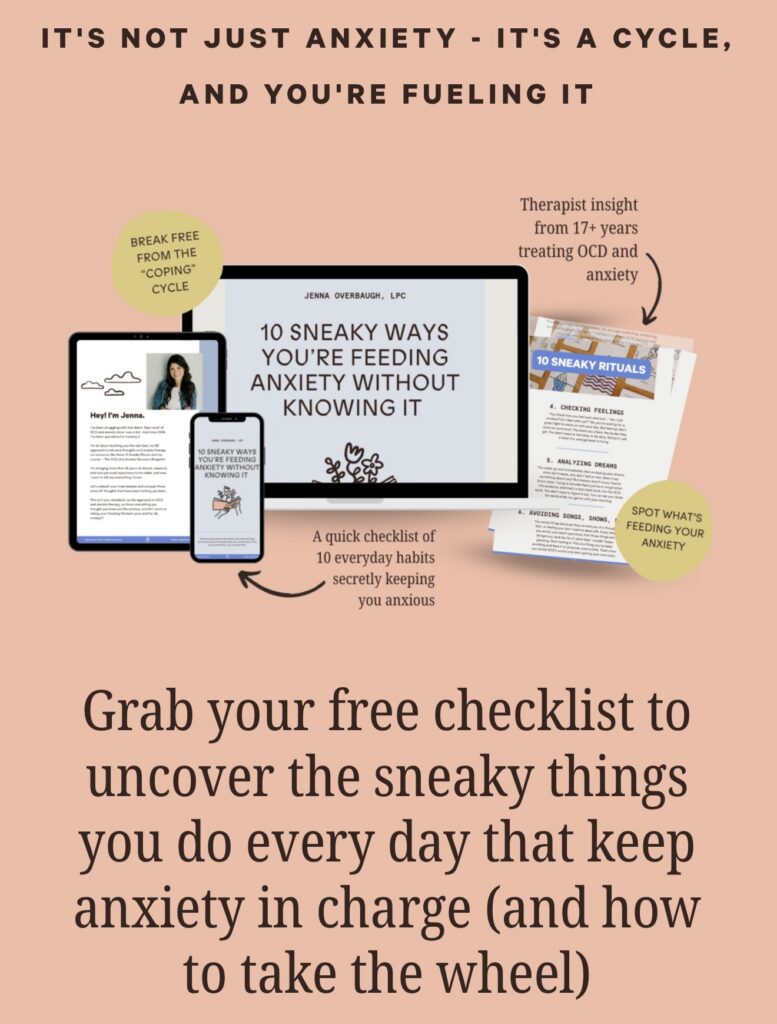
And if this blog made you realize your OCD might be disguising itself as “working on yourself,” start here – totally free, totally yours to download: 10 Sneaky Ways You’re Feeding OCD & Anxiety
Talk soon!
Jenna


most popular episodes
Love my podcast?
Episode 112: Postpartum OCD and False Memory OCD
Imagine how in depth I can go in an online course. Instantly downloadable and game-changing. Take the next step towards an amazing life.