Why Intrusive Thoughts Ruin Your Entire Day (And What Keeps The Spiral Going)
May 19, 2026
The other morning I walked into my kitchen half awake, grabbed my water bottle, took one sip, and immediately noticed black fuzz around the mouthpiece.
Absolute prison.
I stared at it for like two full seconds while my brain instantly tried to launch into:
“What if you already swallowed mold?”
“What if you get sick?”
“What if there’s mold everywhere?”
“What if the whole kitchen is contaminated?”
You know. Casual.
This is what most people don’t get about OCD and anxiety.
The intrusive thought itself (OMG MOLD MOLD MOLD MOLD) actually wasn’t the thing that could’ve ruined my morning.
It was everything my brain WANTED me to do next.
Because once anxiety gets loud, your brain wants to do/get this:
- certainty
- reassurance
- checking
- Googling
- analyzing
- solving
- immediate action
- full environmental investigation by 7:14 AM
That part is what hijacks your day. Not the first thought but the spiral afterward.
And if you’ve ever wondered why intrusive thoughts ruin your entire day, this is usually where things start going sideways.

Why Intrusive Thoughts Feel So Powerful
One of the biggest mistakes I see online is people treating intrusive thoughts like they’re dangerous because they FEEL intense.
Unfortunately, OCD loves using emotion as fake evidence.
Something feels scary, urgent, disgusting, wrong, irresponsible, unsafe, unacceptable, or unresolved, and your brain immediately goes:
“Okay well now we obviously have to deal with this immediately.”
I’ve worked with OCD and anxiety since 2008. I’ve worked in residential settings with people whose lives completely stopped because of these spirals.
And the common denominator is almost never the content of the thought.
It’s the relationship TO the thought.
Somebody else can have the exact same intrusive thought and move on with their day because their brain never opened seventeen tabs trying to solve it.
Meanwhile OCD grabs the thought and makes it the most important, urgent, desperate thing.
Now your brain isn’t even able to access logic because it’s so focused on fight or flight.
Now you’re mentally reviewing.
Now you’re checking your feelings.
Now you’re researching symptoms on Reddit while pretending it’s “just curiosity.”
Now it’s noon and you haven’t left the original thought from 8 AM.
The Sneaky Mental Compulsions People Miss
A lot of people still think compulsions are only visible things.
Handwashing.
Checking locks.
Counting.
And sure, sometimes those are huge issues.
But some of the most exhausting compulsions happen completely inside someone’s head.
Things like:
- replaying conversations
- checking whether you “feel okay”
- trying to figure out if the thought means something
- mentally reviewing memories
- comparing today to yesterday
- trying to get certainty before moving on
- confessing things for relief
- researching for hours
- asking people “do you think this is normal?”
- monitoring your reactions constantly
I cannot tell you how many times people have told me something along the lines of “I spend the entire day arguing with myself in my head.” This is exactly what this feels like for so many people.
It’s exhausting. Your brain never gets a chance to clock out, no wonder you’re exhausted.
And unfortunately, most people don’t even realize these are compulsions. They just think they’re “trying to be responsible” or “trying to understand.”
Meanwhile the brain is learning: “Wow. We really care about this thought. Let’s keep sending more.”
Which is why the cycle gets louder over time.
(I talk more about this cycle in my Break the Cycle Masterclass. Click here to check it out.)
The First Few Minutes Matter More Than People Realize
One thing I wish more people understood about OCD recovery is how fast these patterns happen.
The spiral usually starts WAY before someone is fully panicking.
It starts in tiny moments that seemingly pass you right on by.
The quick Google search.
The mental replay.
The checking.
The reassurance text.
The “wait let me think about this one more time.”
That’s why I’m constantly teaching people to pay attention to what happens immediately after the trigger, because the first few minutes often determine whether your brain settles down or builds a full psychological escape room around the thought.
And listen. I know how automatic this stuff feels.
I’ve had clients tell me they don’t even realize they’re doing compulsions until 45 minutes later.
Yep.
That’s normal.
Especially with mental compulsions.
They’re sneaky as hell.
That’s also why education matters so much. You can’t interrupt a pattern you don’t know you’re doing.

What Actually Starts Helping
The people I see make the biggest progress usually are not the people who become fearless overnight. Oh what a dream that would be.
They’re the people who slowly stop organizing their entire lives around getting certainty.
And that process can feel VERY weird at first.
Because your brain will absolutely throw a tantrum when you stop immediately engaging with every intrusive thought.
I always tell clients this feels less like becoming some magical zen robot and more like “Ohhhhkay my brain is yelling and I’m still packing my kid’s lunch anyway.”
That’s the work.
Repeated over and over and over again. Just real life practice.
If Your Brain Immediately Spirals After An Intrusive Thought
This is exactly why I’m teaching my live masterclass, THE 30-SECOND SHIFT, on May 26.
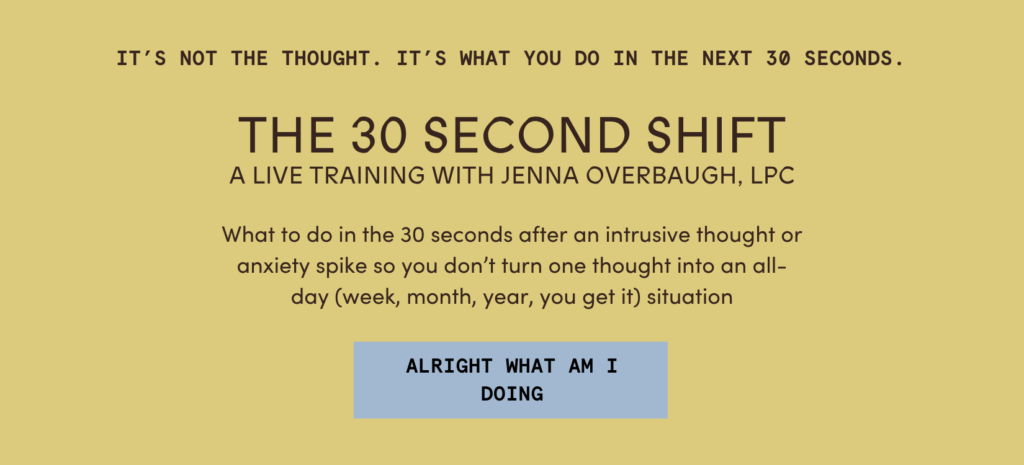
Because most people are trying to stop the spiral after they’re already six exits deep into it.
We’re going to talk about:
- what happens in your brain immediately after a trigger
- why intrusive thoughts ruin your entire day sometimes
- the hidden compulsions people miss
- the mistakes that accidentally feed OCD and anxiety
- what to actually DO in those moments instead
Very practical. Very real-life. Very much “what do I do when my brain is trying to ruin my Tuesday at 8:07 AM.”
You can save your spot here: THE 30-SECOND SHIFT
And if this blog has you realizing your brain spends a LOT of time stuck in invisible spirals, start with these too:
- Free Spiral & Mental Compulsions Video
- 10 Sneaky Ways You’re Feeding OCD & Anxiety
- Free Scripts To Interrupt The Loop
And if you want some wearable reminders for the days your brain is acting like a feral raccoon, my merch shop is here too:
We have to stop thinking about recovery as ~never having intrusive thoughts again~. That can’t happen. What can happen is you learning to stop letting them ruin your entire day.
See you on May 26th (one last link for you! Save your spot here for the 30 Second Shift),
Jenna




most popular episodes
Love my podcast?
Episode 112: Postpartum OCD and False Memory OCD
Imagine how in depth I can go in an online course. Instantly downloadable and game-changing. Take the next step towards an amazing life.